
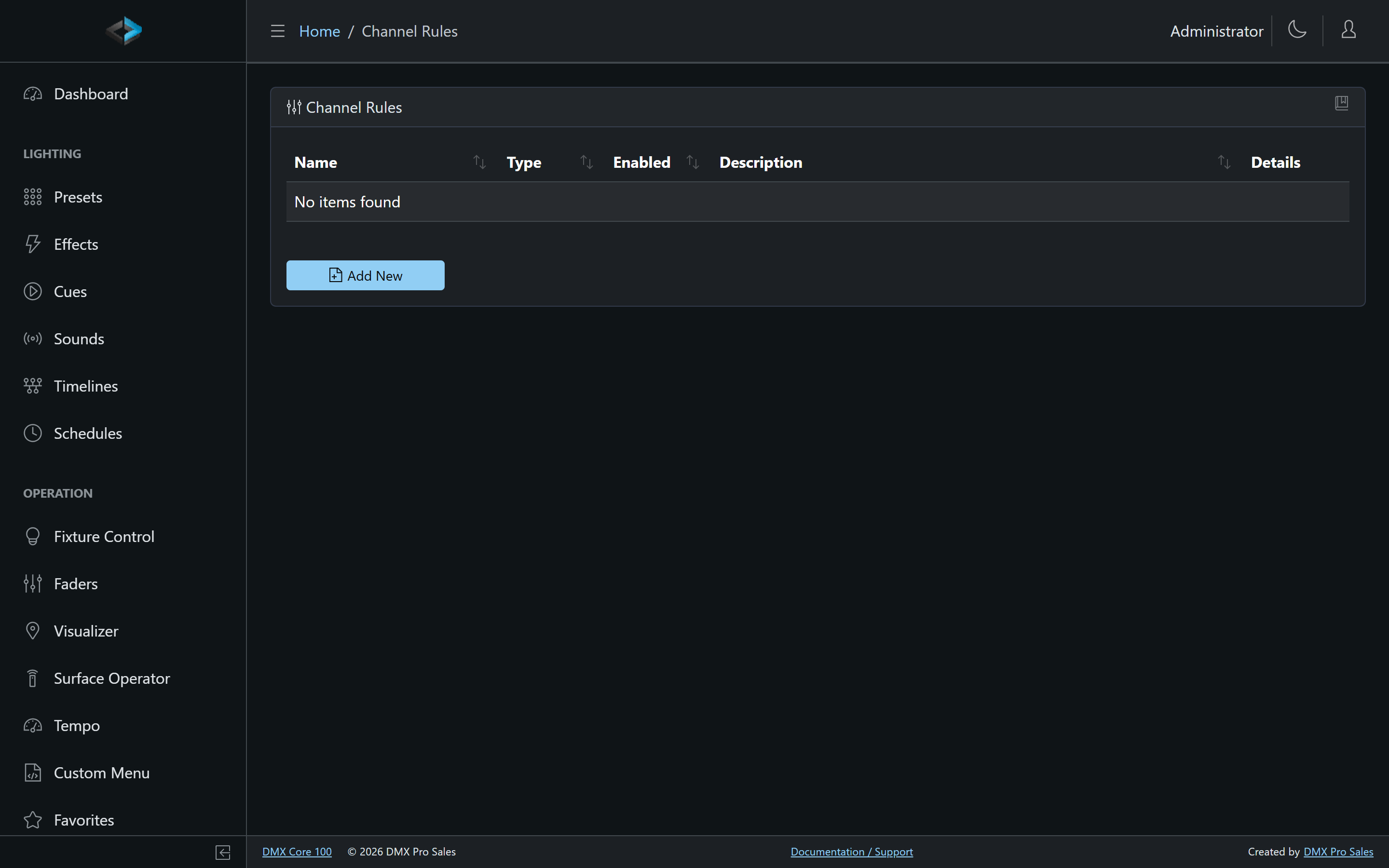
Channel Rules
Channel rules adjust recorded DMX data on the fly during cue playback - without modifying the cue files. Use them when a show is already recorded but something on site has changed: fixtures that were recorded too bright can be capped or scaled down, and fixtures added after the recording can mirror existing channels (multipatch).
When rules apply
Rules apply to cue playback only - both dynamic (recorded) and static (snapshot) cues, including cues played from timelines. They never affect fixture control, presets, or effects; to change those, edit the fixtures or presets directly.
Rules are global: once defined, they apply to every cue that touches the matching channels. They take effect immediately when saved - even during playback - so you can fine-tune a limit while watching the result on the fixtures. Recording is unaffected, and cue files are never changed; disable or delete a rule to instantly restore the original output.
Rule types
Each rule targets a Slot Id (the internal universe id as recorded in the cue) and a channel range (1–512). To see which slots a cue uses, open the cue in the Web UI (Lighting > Cues, then the cue name) and read Used Slot/Universe Ids.
Cap
Limits channels to a maximum value. Values at or below the limit pass through unchanged; values above it are held at the limit.
Example: a cap of 128 leaves a recorded 100 untouched but outputs 128 when the recording says 255.
Scale
Rescales the whole 0–255 range so that full level becomes the limit - the recorded look keeps its relative intensity shape, just dimmer.
Example: with a scale limit of 128, a recorded 255 outputs 128 and a recorded 127 outputs 64.
Copy
Duplicates a channel range to another location - the same or a different slot. The copied channels follow the recorded data through fades and the cue dimmer, so a fixture added after the show was recorded behaves exactly like the original it mirrors.
Set the Destination Slot Id and Destination Start Channel; the range keeps its length, so it must fit within channels 1–512 at the destination.
Processing order
Within each frame, rules apply in a fixed order: copies first, then scales, then caps.
- A cap or scale addressing the copy destination also limits the copied data - so a newly added fixture can be both copied and capped.
- Copies read values before scales and caps are applied to the source.
- Caps run last, after the cue dimmer and any fades, making a cap an absolute output ceiling for its channels.
Overlapping limit rules combine predictably regardless of order: multiple caps on the same channel enforce the lowest limit, and multiple scales multiply together.
Managing rules
The Channel Rules list shows each rule’s type, enabled state, and a summary such as “Cap slot 1 ch 3 at 100”. From the details page you can:
- Enable/disable a rule - takes effect immediately, also during playback.
- Duplicate a rule - the copy is created disabled so it can’t double-apply before you’ve edited it.
- Delete a rule.